Our sincere thanks to Peter Mook, whose time, expertise, and dedication helped bring this article to life and preserve the historical accuracy behind these collectibles.
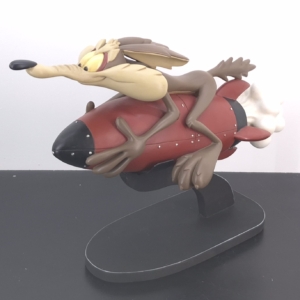
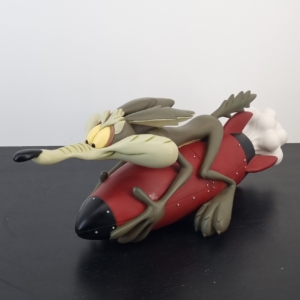
Within the collector community, few stories circulate as persistently as the claim that the Wile E. Coyote Rocket statue with base is a rare Japanese edition. Over the years, this assumption has been repeated often enough that it became accepted as fact in certain circles. However, this narrative is incorrect.
The truth is far more straightforward — and arguably more interesting.

Origin of the Base Version: A Practical Solution by Spanish Importer Merxes
The base version was not developed as an exclusive Japanese release. Instead, it originated through a Spanish importer named Whanko, whose import company operated under the name Merxes. According to accounts from those involved at the time, Whanko received repeated feedback from customers who loved the statue but did not want to suspend it from the ceiling. Many collectors preferred to display the piece in a cabinet or on a shelf.
Peter Mook’s Custom Base Design: Transforming a Hanging Sculpture into a Freestanding Display
In response to this practical demand, Peter Mook quickly designed a custom display base specifically for this statue. The goal was simple: allow collectors to showcase the dynamic rocket sculpture as a freestanding display piece rather than a hanging object. This adaptation preserved the original sense of motion and balance while offering significantly greater flexibility in how the piece could be presented. The base was engineered to complement the sculpture aesthetically, ensuring it felt like a natural extension of the original design rather than an afterthought. As a result, collectors could integrate the statue seamlessly into display cabinets, shelves, or curated environments without compromising its visual impact.
Limited Production, Not Regional Exclusivity
Production numbers for the base version were modest. Only a limited quantity was ultimately sold, not because it was intended as a regional exclusive, but simply because it was a later adaptation driven by specific customer demand. The smaller number in circulation likely contributed to the confusion and helped fuel the “Japanese special edition” narrative.
Two Authentic Variants, One Shared Origin
Today, both versions — with and without base — remain authentic and legitimate releases. The difference lies not in geographic exclusivity, but in display functionality and distribution history.
As with many collectible myths, the reality is less exotic but more grounded in practical collector culture. Understanding this distinction helps preserve the historical accuracy of the piece and prevents mislabeling that can distort market perception.
A Commitment to Historical Accuracy
At Precious Collectibles, we actively research and document the verified history behind important releases such as the Wile E. Coyote Rocket statue. By working directly with original artists, original distributors, collectors, and archival sources, we aim to distinguish documented facts from long-standing collector assumptions.
This research confirms that the base version was not a Japanese exclusive, but a practical adaptation initiated by a Spanish importer to meet collector demand. Both variants remain authentic releases, each reflecting a different approach to display rather than regional exclusivity.
Preserving these distinctions is essential to maintaining historical accuracy, protecting collector confidence, and ensuring the true provenance of Peter Mook’s work remains correctly understood.